


Table of Contents
India receives more money from people working abroad than any other country on earth. The World Migration Report puts the number above $125 billion a year, and the World Bank still measures average global remittance costs above 6% of the amount sent, well over the United Nations target of 3%. If you send $500 to family in India through a bank, you can lose $20 or more before your family sees a single rupee. Then you wait two to five days for it to land.
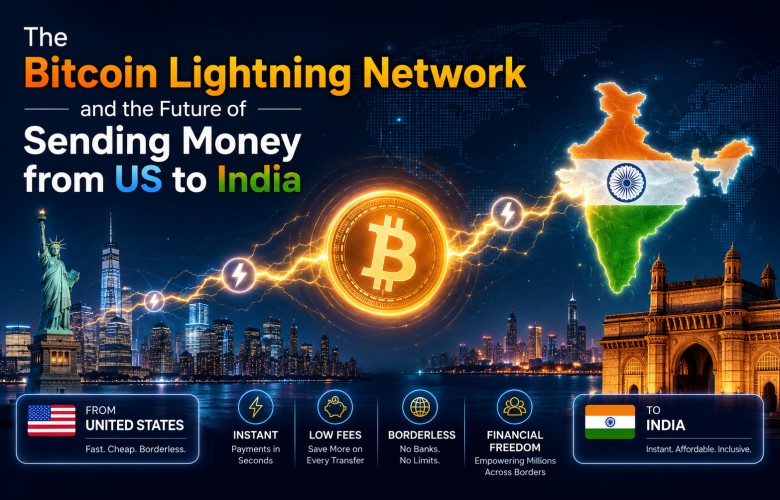
The Bitcoin Lightning Network changes that math. It moves value in seconds, for a fraction of a cent, without a bank in the middle. Here’s how it works, and how you can use it today.
Why sending money from the US to India still costs so much
A traditional bank wire to India passes through several intermediary banks before it reaches the recipient’s account. Each one takes a small cut, and the exchange rate you get is rarely the real market rate. Providers add their own markup on top of the mid-market rate, so the fee you see at checkout is never the full cost.
Speed is the other problem. A SWIFT wire can take two to five business days. If your family in India needs money for a medical bill or a school payment today, a multi-day wait isn’t good enough.
Money transfer apps like Wise, Remitly, and Western Union have made this faster and cheaper than a traditional bank, and they remain solid options for many people. But they still depend on a chain of banks and payment processors behind the scenes. Bitcoin removes that chain entirely.
What the Bitcoin Lightning Network actually is
Bitcoin’s main network confirms a new block roughly every ten minutes, which makes it slow and sometimes expensive for everyday payments. The Lightning Network is a second layer built on top of Bitcoin that solves this. It lets you send Bitcoin instantly and cheaply by opening payment channels between users instead of recording every single transaction directly on the blockchain.
Joseph Poon and Thaddeus Dryja first proposed this design in 2015, and it has run in production since 2018. Today it handles real payments for coffee shops, freelancers, content creators, and increasingly, cross-border remittances.
For someone sending money from the US to India, Lightning means the transaction settles in seconds, and the fee is usually a fraction of a cent, no matter how much you send.
Buying Bitcoin with a credit card is the easy part
You don’t need to understand blockchain technology to use this. Apps like EvoMone let you buy Bitcoin with a credit card, debit card, Apple Pay, or Google Pay, through a regulated payment partner. You confirm your amount, complete a one-time identity check, and the Bitcoin lands directly in your wallet, usually within minutes.
From there, sending it to India over the Lightning Network takes seconds. No wallet address to type out letter by letter, no waiting for a bank to open. You buy, you send, it arrives.
Why a self-custody wallet matters
This is the part most remittance apps don’t offer you: control over your own money.
When you send money through a bank or a traditional remittance company, your funds pass through several custodians before they reach the recipient. Each one is a company that can freeze an account, delay a transfer, or make a mistake that takes days to fix.
A self-custody bitcoin wallet works differently. You hold the private keys, which means you hold the Bitcoin directly, not a company’s promise to give it to you later. No third party can freeze it, block it, or lose it in a database error.We cover this in detail in our guide on how safe self-custody wallets like Electrum really are, and the same principle applies to any self-custody bitcoin wallet, not just Electrum.
With a self-custody wallet, your Bitcoin belongs to you from the moment you buy it until the moment you send it. That is the whole point.
How to send money from the US to India with Bitcoin Lightning
Here’s the process from start to finish:
- Download a self-custody wallet built on the Lightning Network, such as EvoMone.
- Buy Bitcoin with your credit card, debit card, or bank transfer. The purchase settles in minutes and lands directly in your own wallet.
- Send Bitcoin to your recipient in India. If they already use a Lightning wallet, you send it directly to their address or username. If they’re new to Bitcoin, you invite them to download a wallet so they can receive it.
- Your recipient holds Bitcoin, or converts it to rupees through a local exchange or on/off-ramp partner in India, depending on what they need it for.
The entire transfer, once both sides have a wallet, takes seconds. Compare that to a bank wire sitting in a clearing queue for three days.
Is it safe?
Yes, provided you use a regulated on-ramp and a wallet where you control your own keys. The two biggest risks in any money transfer are a company holding your funds without your consent, and a payment provider that isn’t properly licensed. A self-custody wallet solves the first problem. Choosing a payment partner with proper licensing, like MoonPay, solves the second.
The Lightning Network itself is public, open-source, and has run in production for years. It doesn’t belong to any single company, and no one can shut it down.
Frequently asked questions
Yes. Once you own Bitcoin in a self-custody wallet, you can send it directly to anyone with a Lightning wallet, with no bank account needed on either side.
No. Modern wallets handle the technical side. You buy Bitcoin with a card, tap send, and your recipient gets it. That’s the whole process.
Lightning fees are usually a fraction of a cent per transaction, regardless of the amount you send. Compare that to the 5-6% average cost of traditional remittance to South Asia.
You can invite them to download a wallet in a few minutes. Once they have one, they can receive your payment immediately.
Yes, it’s the same Bitcoin. Lightning is a faster settlement layer built on top of the Bitcoin network, not a separate currency.
The bottom line
Banks built the current remittance system around their own infrastructure, and every fee reflects that. The Bitcoin Lightning Network was built around the payment itself, not the institutions in the middle. For families sending money from the US to India, that difference means seconds instead of days, and cents instead of a 5-6% cut.
If you want to see exactly what your transfer would look like in Bitcoin terms, start with our crypto profit calculator to check current rates before you send.

 English
  Español
  Français
  Deutsch
  Polski
  العربية
  हिन्दी
  Español de Perú
  Español de Costa Rica
  Português